

Re-Anchoring Central India: The Economic Mechanics of the Samruddhi Corridor
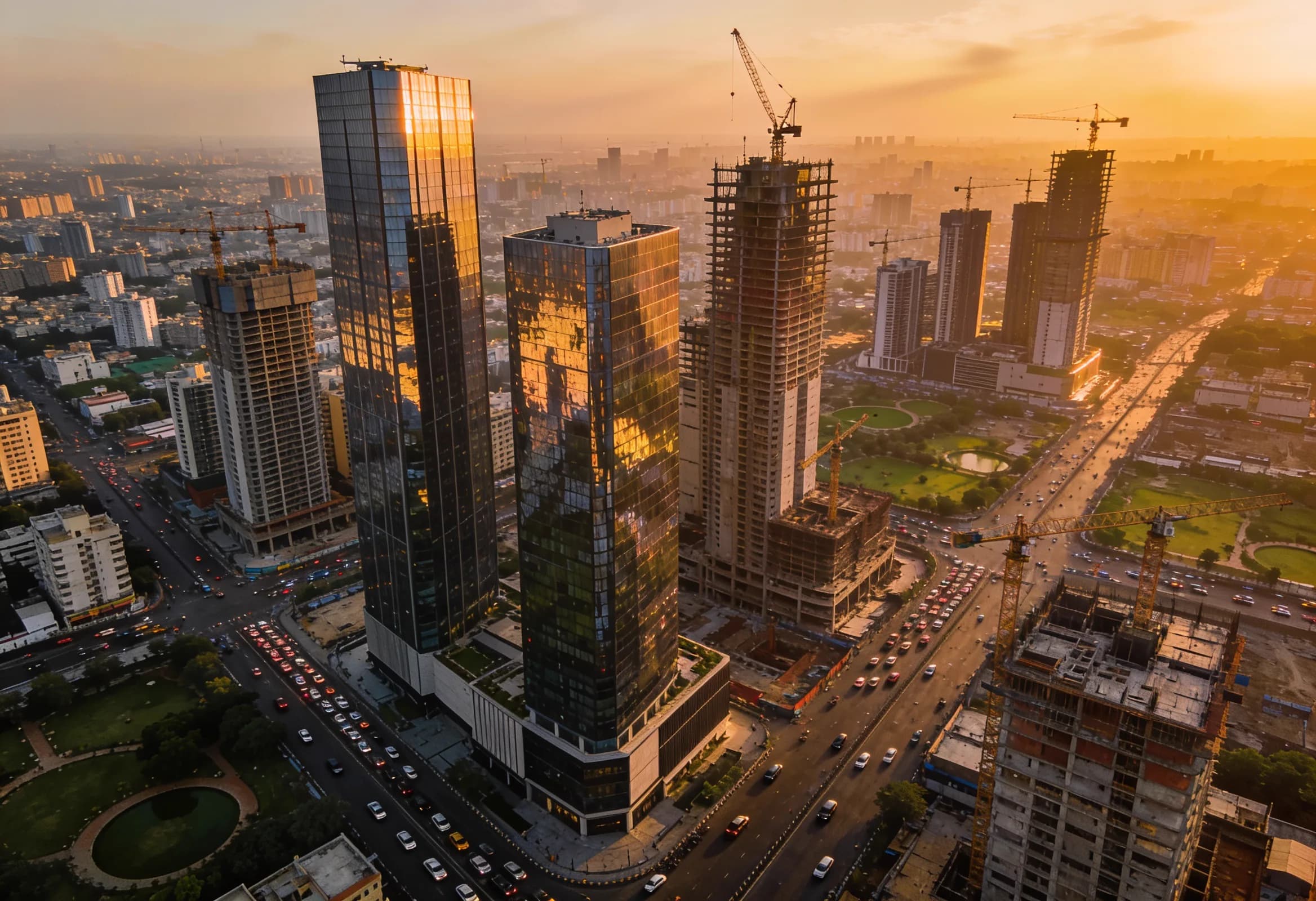
Transport infrastructure fundamentally changes land valuation by altering the relationship between distance and time. Prior to large-scale corridor development, rural land values decayed predictably as distance from the urban core increased. The opening of major transit arteries disrupts this traditional linear model, creating localised pockets of high economic utility where high-speed roads connect with regional feeder networks.
The completion of the Hindu Hrudaysamrat Balasaheb Thackeray Maharashtra Samruddhi Mahamarg has introduced this exact structural shift across central India. The Samruddhi Mahamarg is 701 km and fully operational, putting Mumbai roughly eight hours from Nagpur by road. By compressing transit times and integrating agricultural land into national supply chains, the expressway has established an economic corridor that functions independently of historical city boundaries.
Supply Chain Realignment and Industrial Siting
Industrial site selection is driven by predictable transit windows rather than physical proximity to urban centres. Modern manufacturing, freight, and third-party logistics operators calculate land utility based on turn-around times, toll efficiency, and seamless arterial access.
According to JLL (2025), Grade-A office stock is projected to grow 26% by 2027 as national occupiers move in. This expanding corporate footprint across central India relies directly on freight corridors capable of moving raw materials and finished goods to western ports without urban traffic bottlenecks. The alignment of the expressway provides heavy industrial users with bypass routes around congested municipal centres. Consequently, land parcels situated near logistics nodes have transitioned from agricultural valuations to commercial asset classes.
Land near the Samruddhi corridor is projected to appreciate 5.2 times by 2035.
Colliers, 2025
The Node Effect: Why Interchanges Outperform Road Frontage
A common misconception in corridor investing is that land adjacent to an expressway appreciates uniformly along its entire length. In practice, high-speed, limited-access expressways create value almost exclusively at controlled access points. Direct road frontage without an exit ramp offers operational utility only to agricultural or low-density uses.
Value creation concentrates at the interchanges where entry, exit, and toll facilities link the high-speed trunk line to local state highways. According to research published by Colliers in 2025, land near the Samruddhi corridor is projected to appreciate 5.2 times by 2035. This projected appreciation is concentrated primarily at these strategic interchange nodes. At these points, freight terminals, warehousing parks, commercial service centres, and hospitality facilities can assemble land with direct legal and physical access to national distribution networks.
Corridor Speculation Versus Urban Core Valuations
Institutional investors and homebuyers must distinguish between land value driven by immediate economic activity and land value driven by long-term strategic positioning. Both asset types play different roles within a balanced portfolio.
Urban core properties in Nagpur derive their valuation from immediate civic infrastructure, existing residential density, and proximity to primary employment hubs. According to figures presented to the Maharashtra Assembly in 2026, 1.27 lakh jobs have been created at the MIHAN special economic zone. This existing workforce generates immediate residential and commercial rental demand within established city limits. Conversely, land along the expressway corridor derives its value from long-term capital appreciation driven by regional macro economics. While central urban land delivers immediate yield and end-user liquidity, corridor parcels represent long-duration land holdings tied to multi-decade industrial expansion.
Economic Interdependence: Macro Growth Anchors
Infrastructure corridors do not generate value in isolation; they amplify the existing economic strengths of the regions they connect. The long-term performance of land along the expressway is linked directly to the broader economic trajectory of central India.
According to Oxford Economics, Nagpur is projected the 5th fastest-growing city economy in the world, at 8.41% GDP growth from 2019 to 2035. This sustained macro growth provides the baseline economic momentum required to absorb industrial, commercial, and residential land along the expanding corridor. As regional GDP expands, freight volumes along the artery increase, reinforcing the long-term utility of logistics hubs, assembly plants, and commercial nodes established near key exits.
Evaluating Risks: Illiquidity and Long-Term Timelines
Analysing corridor land requires an objective evaluation of structural risks and execution timelines. A balanced investment approach must account for the specific frictions associated with greenfield real estate holdings.
First, corridor land holdings are inherently illiquid compared to developed urban assets. Secondary markets for large agricultural or industrial land parcels take time to form, and exit horizons must be measured in years rather than months. Buyers holding corridor land must be prepared for extended holding periods during phase-wise industrial absorption.
Second, long-term market forecasts must be understood as broader economic indicators rather than fixed schedules. While long-term appreciation projections reflect macroeconomic fundamentals, actual land monetisation depends on municipal zoning shifts, secondary infrastructure connections, and local utility installation. A forecast to 2035 reflects a multi-year trajectory, not an immediate or linear delivery schedule.
Analytical Due Diligence for Modern Buyers
Navigating the commercial opportunities created by major transport corridors requires rigorous due diligence. Successful market positioning depends on evaluating verified access rights, statutory land-use classifications, and realistic development horizons.
This is not financial or investment advice. Please take independent professional advice before you invest.
Kukreja Infrastructures has been developing real estate projects across Nagpur for fifteen years, monitoring urban expansion and infrastructure development across central India.